
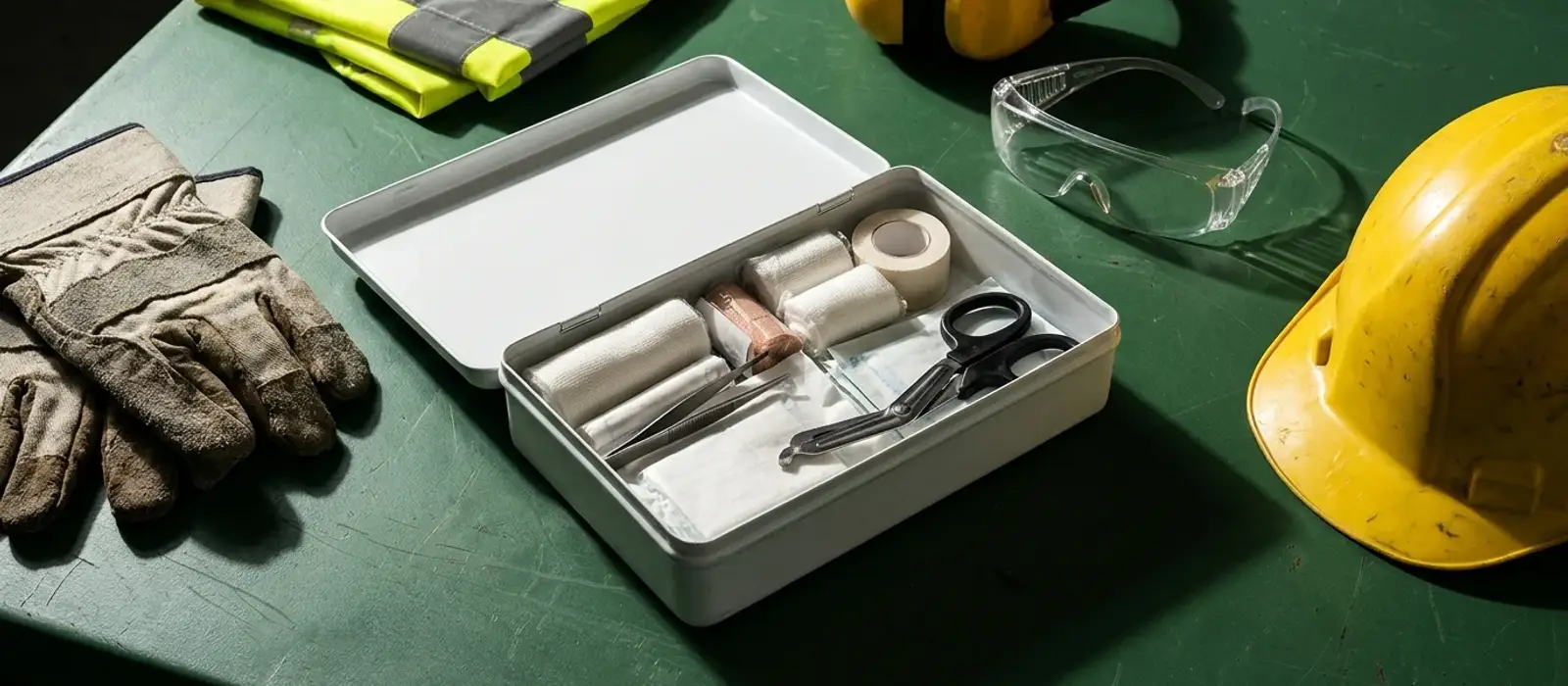
If anyone at your workplace could get an injurious corrosive material in their eyes or on their body, OSHA requires an eyewash, and where the body is exposed, a drench shower. The rule is 29 CFR 1910.151(c): "suitable facilities for quick drenching or flushing of the eyes and body shall be provided within the work area for immediate emergency use." The OSHA rule gives no distances, flow rates or test schedules. For those details OSHA points employers to the consensus standard ANSI/ISEA Z358.1, which OSHA treats as guidance rather than law.
When OSHA Requires an Eyewash Station
The trigger is exposure to injurious corrosive materials. Construction has the same wording at 29 CFR 1926.50(g). In a 2009 letter, OSHA said that if none of the materials used in a work area is an injurious corrosive (judged from each product's Safety Data Sheet), an eyewash or shower is not required under 1910.151(c).
OSHA's eyewash InfoSheet (OSHA 3818) lists other rules that call for eyewash facilities:
- Corrosive chemicals: 1910.151(c).
- HIV and HBV research laboratories and production facilities: 1910.1030(e)(3)(i).
- Formaldehyde: where eyes may be splashed with solutions of 0.1 percent or more formaldehyde, 1910.1048(i)(3).
Two other OSHA positions matter when deciding what to install:
- Protective eyewear is not a substitute. In a 2015 letter on ammonia refrigeration, OSHA said it would not accept personal protective equipment in place of eyewash or safety showers. You still need goggles or face shields under the PPE rules, plus the eyewash.
- Removing the exposure can remove the requirement. In a 2013 letter on forklift battery charging, OSHA said a battery-watering system that completely eliminates employee exposure to battery acid means quick-drench facilities are not needed for that acid, though other corrosive exposures in the workplace would still require them.
How OSHA Uses ANSI Z358.1
OSHA has never adopted ANSI Z358.1 as a rule. A November 1, 2002 letter states that ANSI standards become mandatory OSHA standards only if OSHA adopts them, and that OSHA does not enforce the Z358.1 versions it reviewed. Any citation for unsuitable eyewash or shower facilities is issued under 1910.151(c), and the letter notes it can be a serious citation.
In practice, ANSI is the yardstick. A 2010 OSHA letter says that if an emergency eyewash complies with ANSI Z358.1, "such compliance will usually meet the intent of the OSHA standard." A 2020 letter says ANSI standards are not binding but "provide technical information to help determine sufficiency."
The full ANSI standard is a paid document. The details below are only those OSHA has quoted or summarized in its own letters and publications.
Distance: The 10-Second Rule
ANSI Z358.1 does not set a fixed number of feet in the parts OSHA has quoted. It sets a time:
- The 2010 OSHA letter, citing Section 5.4.2 of ANSI Z358.1, says the eyewash should be "in an accessible location that is on the same level as the hazard and can be reached by the employee in no more than 10 seconds."
- A 2002 OSHA letter, citing the 1998 edition, adds that where a strong acid or caustic is used, the unit should be immediately adjacent to the hazard.
"Same level" means a worker should not have to climb stairs or a ladder to reach it. Walk the route from each hazard yourself, with your eyes closed or covered and someone guiding you, to see whether 10 seconds is realistic. Doors, clutter and stored pallets in the path all add time.
Flow Rate, Duration and Water Temperature
| Item | ANSI Z358.1 figure as quoted by OSHA | OSHA source |
|---|---|---|
| Eyewash flow | Not less than 1.5 liters per minute (0.4 gpm) | InfoSheet 3818; 2020 letter |
| Flushing time | 15 minutes | InfoSheet 3818; 2020 letter |
| Water temperature | Tepid | InfoSheet 3818 |
| Operation | Activated by a single movement, then hands-free | InfoSheet 3818 |
| Emergency shower flow | Minimum 75.7 liters per minute (20 gpm), enough fluid for at least 15 minutes | April 18, 2002 letter |
Hands-free matters because the injured person needs both hands to hold their eyelids open. In cold areas, OSHA's 2015 letter notes that some eyewash and shower products have built-in heating.
Weekly Activation and Annual Inspection
OSHA itself does not set a test schedule. In an April 2025 QuickTakes answer, OSHA said it does not require a set inspection schedule and recommends following ANSI Z358.1, which suggests:
- Weekly: test (activate) plumbed eyewash stations.
- Yearly: a comprehensive inspection of all eyewash and shower units.
Weekly flushing is also about health. OSHA's InfoSheet warns that water in poorly maintained eyewash stations is more likely to carry organisms such as Acanthamoeba, Pseudomonas and Legionella, which thrive in stagnant water and can cause eye infections or, if inhaled, Legionnaires' disease. It says manufacturer instructions set how often and how long to run specific plumbed units, and generally reference ANSI Z358.1-2014.
A simple program:
- Tag each unit and post a weekly test card on it.
- Each week, activate the unit, confirm water flows from both heads, and note any rust-colored water, low flow or blocked access.
- Keep the dust caps in place between tests.
- Once a year, check each unit against ANSI Z358.1 and the manufacturer's manual, and keep the record.
Portable and Self-Contained Units
Where there is no plumbing, self-contained (gravity-fed or tank) units are an option. OSHA's InfoSheet says self-contained eyewash units must be maintained, and employers should follow the manufacturer's instructions, including flushing the system and using only solutions meant for flushing eyes. They still need to meet the same flow and 15-minute duration to serve as the primary eyewash.
Squeeze bottles are not a replacement. In its 2020 letter on bloodborne pathogens, OSHA said four-ounce bottles are insufficient to flush blood or other potentially infectious materials from the eyes, and that sixteen-ounce bottles may still not be enough to flush for 15 minutes. It suggested a one-liter bag of saline or Ringer's lactate may be more appropriate where an eyewash facility is unavailable. Bottles can be handy for getting started on the way to a full unit, but they do not meet the 15-minute guidance on their own.
Eyewash Station Checklist
- List every product in the area and check its Safety Data Sheet for corrosive hazards.
- Place a unit within 10 seconds of each hazard, on the same level, with a clear path; put it right next to strong acids or caustics.
- Confirm the unit delivers tepid fluid at 0.4 gpm or more for 15 minutes, hands-free.
- Add a drench shower where the body, not just the eyes, can be splashed.
- Activate plumbed units weekly and inspect all units yearly.
- Train workers on where the units are and how to hold eyes open while flushing, and make sure first aid responders know the plan. See our guides to first aid kit requirements and how long CPR certification lasts.
Need units or training? Browse safety equipment suppliers and CPR and first aid training providers near you.
General information, not legal advice. Rules change and State Plan states may differ, so confirm with the current standard or your state agency.
Sources
- OSHA 29 CFR 1910.151, Medical services and first aid
- OSHA 29 CFR 1926.50, Medical services and first aid (construction)
- OSHA InfoSheet 3818: Health Effects from Contaminated Water in Eyewash Stations
- OSHA QuickTakes, April 21, 2025 (eyewash inspection schedule)
- OSHA letter, 2010-10-18: Region V enforcement guidance (ANSI 10-second placement)
- OSHA letter, 2002-03-08: eye wash stations near battery charging
- OSHA letter, 2002-11-01: Using ANSI Z358.1 as guidance for 1910.151(c)
- OSHA letter, 2002-04-18: ANSI Z358.1 guidance and citation policy
- OSHA letter, 2009-06-01: Requirements for eyewash and shower facilities
- OSHA letter, 2013-03-04: Battery acid in battery charging areas
- OSHA letter, 2015-12-16: Eyewash and showers in ammonia refrigeration
- OSHA letter, 2020-11-06: Eyewash for bloodborne pathogen eye hazards