
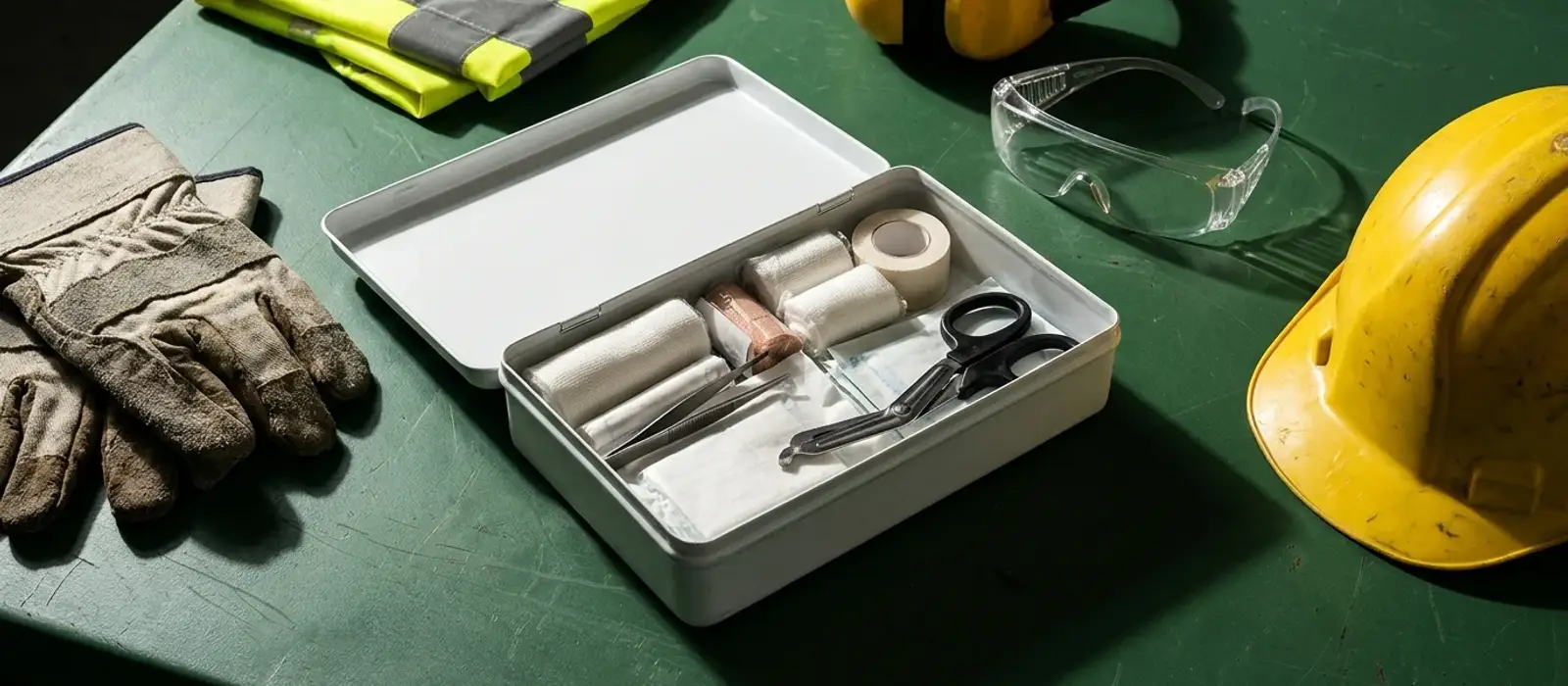
A work-related injury that only needed first aid does not go on the OSHA 300 Log, as long as it did not also cause death, days away from work, restricted work or job transfer, or loss of consciousness, and was not a significant diagnosed condition such as a fracture. OSHA defines first aid as a closed list of 14 treatments in 29 CFR 1904.7(b)(5)(ii). Any treatment that is not on that list counts as "medical treatment beyond first aid," and the case must be recorded.
The Recording Test in Order
Under 29 CFR 1904.4, a case belongs on the log only if it passes three tests:
- It is work-related. An event or exposure in the work environment caused or contributed to the condition, or significantly aggravated a pre-existing one (1904.5). Some cases are excluded, such as injuries that result solely from eating or preparing food for personal use, or from voluntary participation in a wellness program, flu shot or exercise class.
- It is a new case (1904.6).
- It meets at least one general recording criterion in 1904.7, or one of the special rules in 1904.8 to 1904.12 for needlesticks, tuberculosis, hearing loss, medical removal and musculoskeletal disorders.
The first aid question only comes up at step three. If the case is not work-related, the treatment does not matter.
The Six General Recording Criteria
Section 1904.7(a) says a work-related injury or illness is recordable if it results in any of the following:
- Death. The fatality must also be reported to OSHA within eight hours under 1904.39.
- Days away from work. Count calendar days starting the day after the injury, including weekends and holidays the worker could not have worked. You may cap the count at 180 days.
- Restricted work or transfer to another job. This means the worker cannot do one or more routine functions (tasks done at least once a week) or cannot work the full scheduled shift. A restriction that applies only to the day of the injury does not count.
- Medical treatment beyond first aid.
- Loss of consciousness, no matter how brief.
- A significant injury or illness diagnosed by a physician or other licensed health care professional. Cancer, chronic irreversible disease, a fractured or cracked bone, and a punctured eardrum must always be recorded when diagnosed, even with no treatment or restriction (1904.7(b)(7)).
OSHA's Complete First Aid List
The regulation says plainly that this is "a complete list of all treatments considered first aid" (1904.7(b)(5)(iii)). If a treatment is not here, it is medical treatment.
| First aid (not recordable on its own) | Counts as medical treatment (recordable) |
|---|---|
| Non-prescription medication at non-prescription strength | Prescription medication, or an over-the-counter drug recommended by a clinician at prescription strength |
| Tetanus immunization | Other immunizations, such as Hepatitis B or rabies vaccine |
| Cleaning, flushing or soaking surface wounds | |
| Bandages, gauze pads, butterfly bandages, Steri-Strips | Sutures, staples and other wound closing devices |
| Hot or cold therapy | |
| Non-rigid support: elastic bandages, wraps, non-rigid back belts | Devices with rigid stays or other systems designed to immobilize a body part |
| Temporary splints, slings, neck collars or back boards used while transporting a victim | |
| Drilling a fingernail or toenail to relieve pressure; draining a blister | |
| Eye patches | |
| Removing foreign bodies from the eye by irrigation or a cotton swab only | |
| Removing splinters or foreign material (not from the eye) by irrigation, tweezers, cotton swabs or other simple means | |
| Finger guards | |
| Massage | Physical therapy or chiropractic treatment |
| Drinking fluids for relief of heat stress |
Blank cells mean the regulation names no specific counterpart; the general rule still applies that anything off the list is medical treatment.
What Is Not Medical Treatment Either
Three things are excluded from "medical treatment" by 1904.7(b)(5)(i), so they do not make a case recordable by themselves:
- Visits to a physician or other licensed health care professional solely for observation or counseling.
- Diagnostic procedures such as x-rays and blood tests, including prescription medications used only for diagnosis (for example, eye drops to dilate pupils).
- Any of the first aid items listed above.
An x-ray alone does not make a case recordable. If the x-ray shows a fracture, the case is recordable because a fractured bone is a significant diagnosed injury.
Rules That Trip Up Employers
Who Gives the Treatment Does Not Matter
A bandage applied by a doctor is still first aid. Sutures put in by a coworker are still medical treatment. OSHA classifies the treatment, not the person providing it (1904.7(b)(5)(iv)).
A Recommendation Is Enough
If a physician or other licensed health care professional recommends medical treatment, the case is recordable even if the worker never fills the prescription or follows the advice (1904.7(b)(5)(v)). The same goes for days away: if a clinician recommends that the worker stay home and the worker comes in anyway, you record the recommended days (1904.7(b)(3)(ii)).
Vague "Light Duty" Notes
If a note says "light duty" or "take it easy," you may ask the clinician whether the worker can do all routine job functions and work the full shift. If both answers are yes, there is no restriction to record. If you cannot get an answer, record the case as restricted work (1904.7(b)(4)(vii)).
Lower Output Is Not a Restriction
A worker who produces less but still performs all routine functions and works the full shift is not a restricted work case (1904.7(b)(4)(vi)).
Worked Examples
| Situation | Recordable? | Why |
|---|---|---|
| Cut cleaned and closed with Steri-Strips; worker returns to the job | No | Wound cleaning and Steri-Strips are both on the first aid list |
| Same cut closed with three stitches | Yes | Sutures are medical treatment |
| Metal sliver flushed from the eye with water | No | Eye irrigation is first aid |
| Metal sliver removed from the eye with a needle or other tool | Yes | Only irrigation or a cotton swab is first aid for the eye |
| Sprained wrist, ice and an elastic wrap, x-ray negative | No | Cold therapy, a non-rigid wrap and a diagnostic x-ray are not medical treatment |
| Sprained wrist, clinician prescribes a prescription-strength anti-inflammatory | Yes | Prescription medication, even if never picked up |
| Worker faints for a few seconds after a heat exposure | Yes | Any loss of consciousness is recordable |
| Cracked rib diagnosed; no treatment or restriction prescribed | Yes | A cracked bone is always recordable on diagnosis |
What to Do After You Decide
Recordable cases go on the OSHA 300 Log and a Form 301 incident report within seven days of receiving information that the case occurred (1904.29(b)(3)). Our guide to OSHA 300 log recordkeeping covers the forms and who has to keep them. Companies with 10 or fewer employees at all times during the last calendar year are partially exempt from keeping the log (1904.1), though they must still report fatalities and severe injuries.
Each recordable case feeds your total recordable incident rate. See how to calculate TRIR or use the incident rate calculator. Treating a minor injury as first aid when it needed more care does not keep it off the log once a clinician recommends treatment, so send workers to a qualified provider when in doubt. You can find occupational health clinics and safety training and consulting firms in our directory.
General information, not legal advice. Rules change and State Plan states may differ, so confirm with the current standard or your state agency.